Themes by artist and architectural illustrator, Stephen F. Condren, BFA-SAIC, of Condren Galleries, a Fine Arts Gallery, with JPEG & PDF scan and prints of themes #039Q.
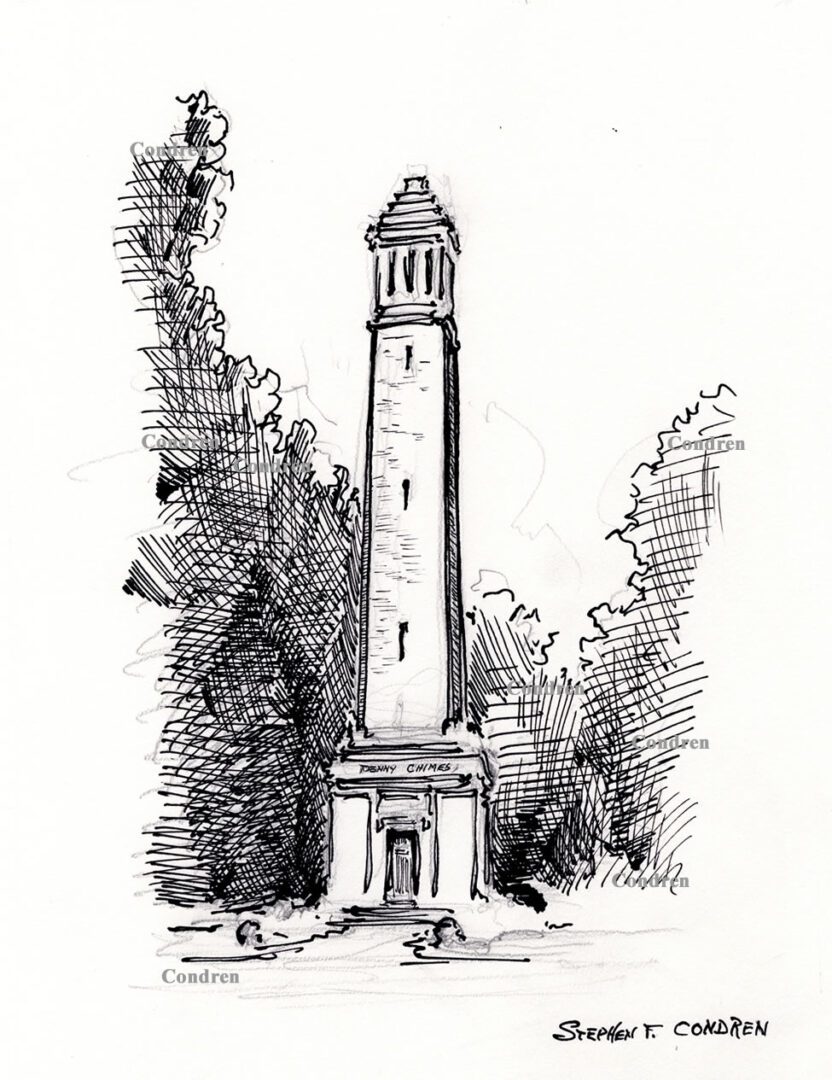
Denny Chimes is named after the beloved George H. Denny, President of University of Alabama. Dr. Denny had wanted to retire, so as a play to keep him on, the University erected this fine campanile tower to keep him on, and it worked!
Pencil Drawing For Denny Chimes #253Z
Clinker Stylus Sketch
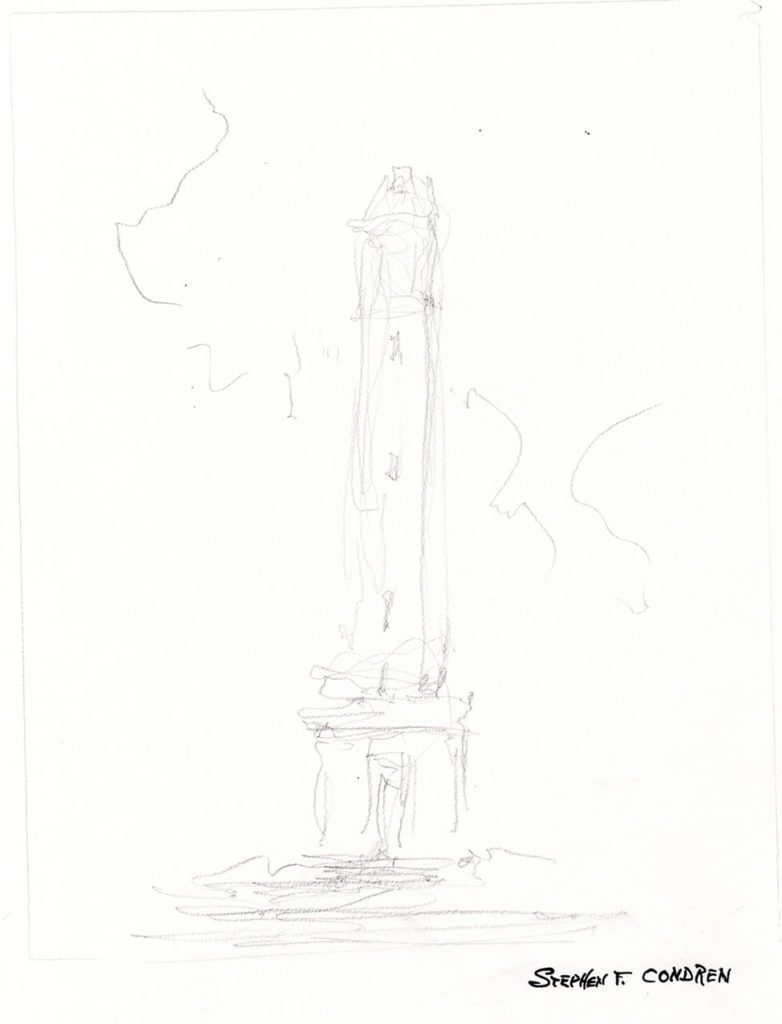
The pencil drawing was done in two phases. First a light layout sketch to give the proper scope and perspective of the drawing. This drawing had to be done very lightly because it is subject to change.
Denny Chines University Of Alabama pencil drawing by artist Stephen F. Condren.
Second Sketch
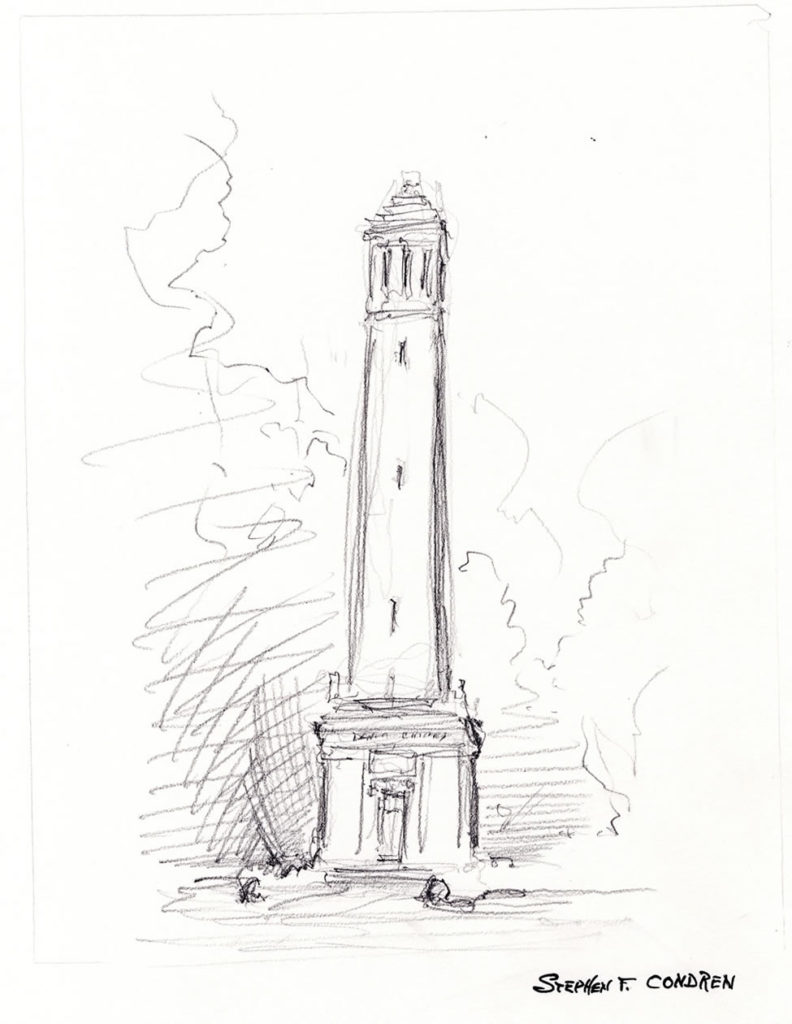
The second sketch is really the final draft to get a real feeling of how the drawing will look when the pen & ink is applied.
Denny Chines University Of Alabama Pencil Drawing
Pen & Ink Drawing
Stylus Sketch
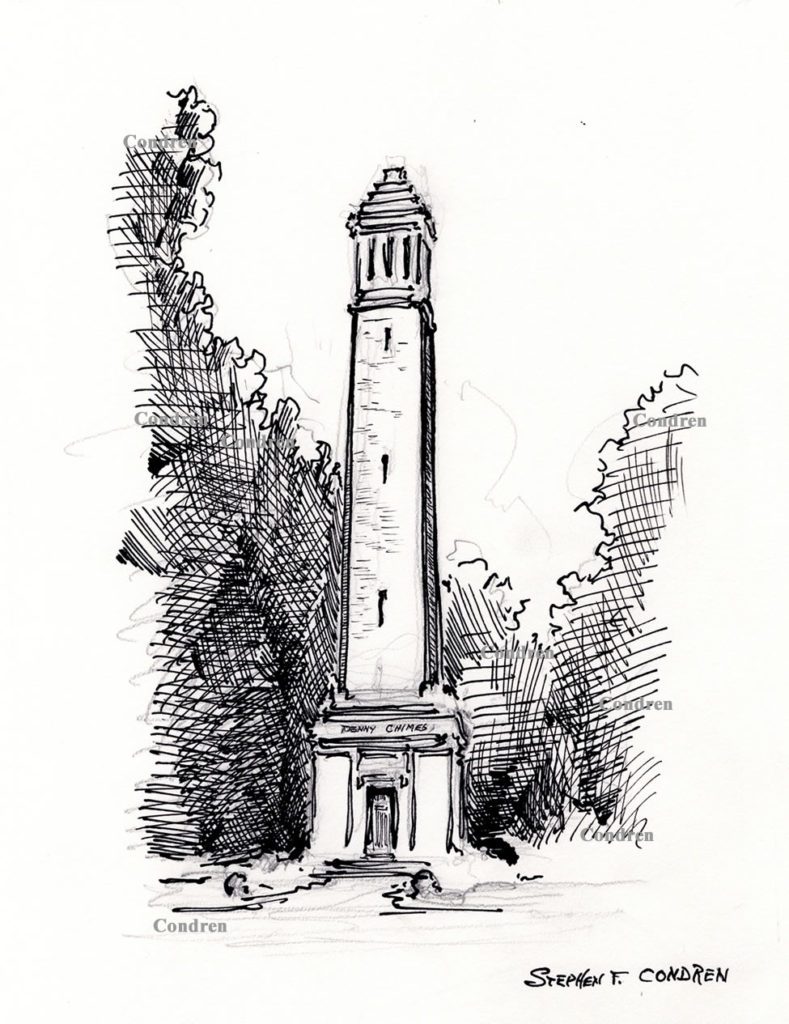
The pen & ink drawing is the last phase of the rendering and as you can clearly see, all of the line work from the preliminary sketches are all in place.
Denny Chines University Of Alabama pen & ink drawing by artist Stephen F. Condren.
Watercolor
Painting
The watercolor rendering.
Scans for Denny Chimes #273Z
JPEG & PDF
Scans of the pen & ink drawing are available in JPEG & PDF formats.
Condren Galleries Ltd. for Denny Chimes #273Z
Fine Arts Gallery
Condren Galleries is pleased to have been to participate in the execution of Denny Chimes #273Z.
Stephen F. Condren
Artist
As an artist I have made Denny Chimes #273Z a staple of my architectural rendering works.
Alt Image Tag
Denny Chimes #273Z pen & ink drawing with prints by Stephen F. Condren at Condren Galleries.
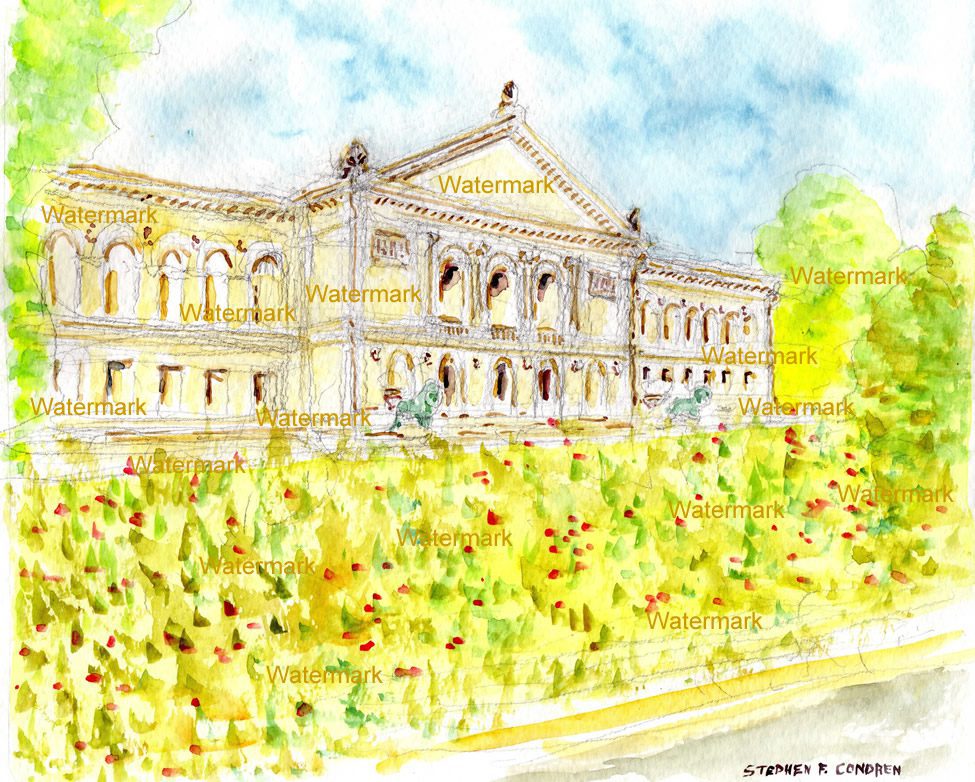
This article is about Art Institute #191B is a landmark watercolor of the Art Institute of Chicago, which is for sale here, at discount with prints by artist Stephen F. Condren, SAIC, of Condren Galleries, a Fine Arts Gallery, offering JPEG & PDF scans. Growing up as a child from the south side of Chicago I would spend many years at the Art Institute of Chicago. In grammar school on weekends, my father sent me to art classes there. He owned the art supply company Favor Ruhl & Watson. At that time it was the largest art supply company in Chicago.
This Beau Arts building was erected as the World’s Congress Auxiliary Building for the World’s Columbian Exhibition of 1893. This was the only structure built for the exhibition outside of Jackson Park. The structure was intentionally designed to become the main building of the Art Institute after the closing of the exhibition.
Key Elements
My focus on the watercolor is Classical entrance of the building. The central block of the building was designed to have a dome over the center. However, since there were not enough funds available the dome was never completed.
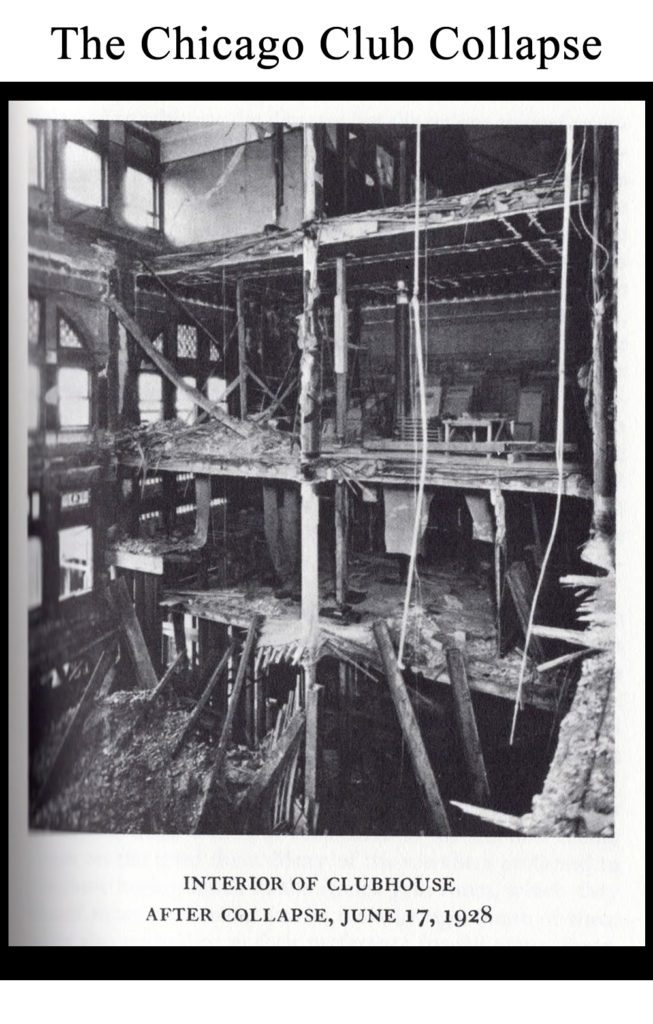
Imagine the Art Institute filled with people during this catastrophe. The loss of lives would be staggering and the loss of many world famous works of art would be forever lost!
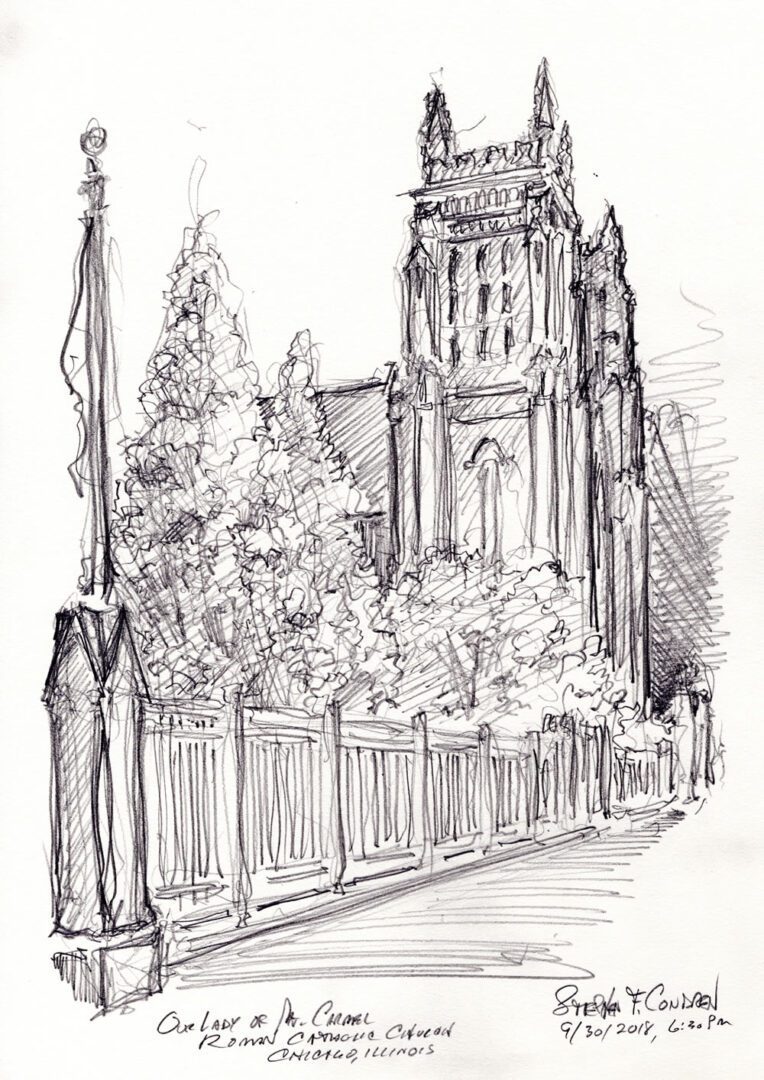
This article is about a pencil drawing of Our Lady of Mt Carmel Church #143B on Belmont Street in Chicago, which is for sale at discount with prints by artist Stephen F. Condren, SAIC, of Condren Galleries, a Fine Arts Gallery, offering JPEG & PDF scans. Our Lady of Mt. Carmel Church is landmark church located on Belmont Street in the Lakeview community of Chicago. This church is precious to me in that it is the church that my parents were married in.
AGLO Chicago
I sat on my stool and drew this picture live before Sunday evening service for AGLO Chicago, where I serve as an acolyte. Because the weather was still warm enough to draw outside, I took advantage of the time. I drew this wonderful building where my mother went to school, and my parents got married in.
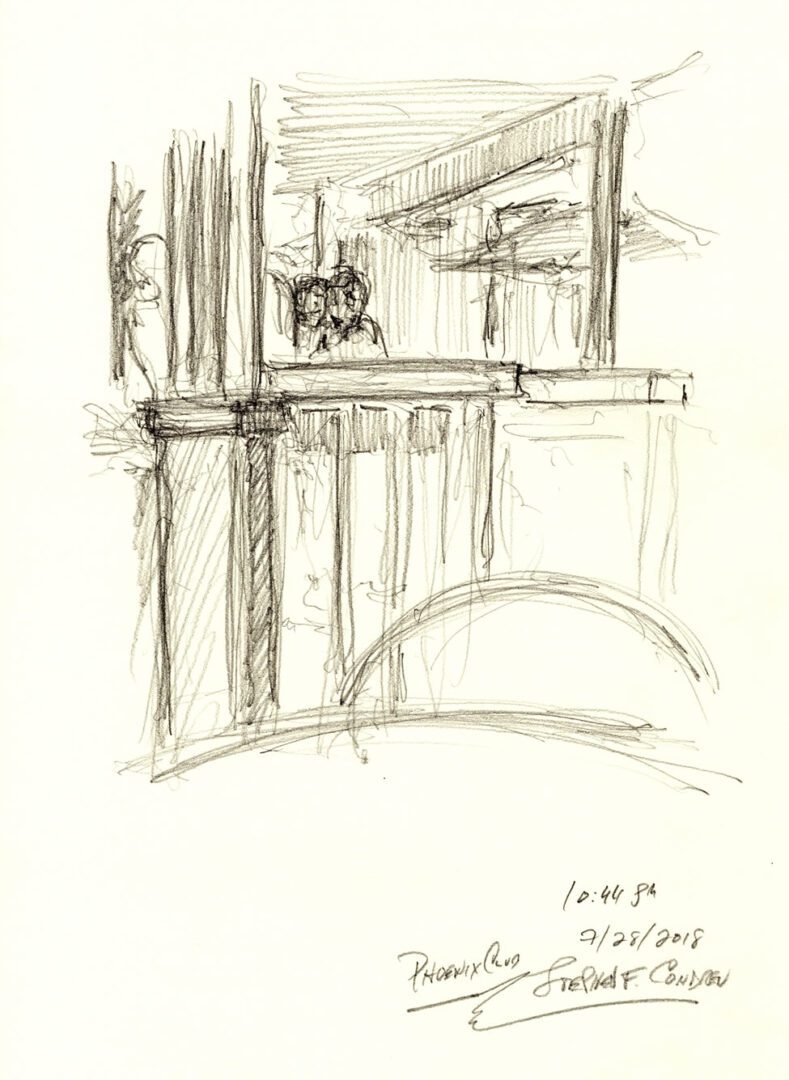
This is about Bar scene of the patio at Phoenix Club, which is for sale at discount with prints by artist Stephen F. Condren, SAIC, of Condren Galleries, a Fine Arts Gallery, offering JPEG & PDF scans. Prints & Scans Of This Drawing #228Z ~ Order Here.
Pencil Portrait
I used a 6B lead which is a soft lead that lends itself to thicker, darker lines.
Lightning Fast Portraits
It took about 15 minutes to draw this bar scene as I was talking with friends as I drew.
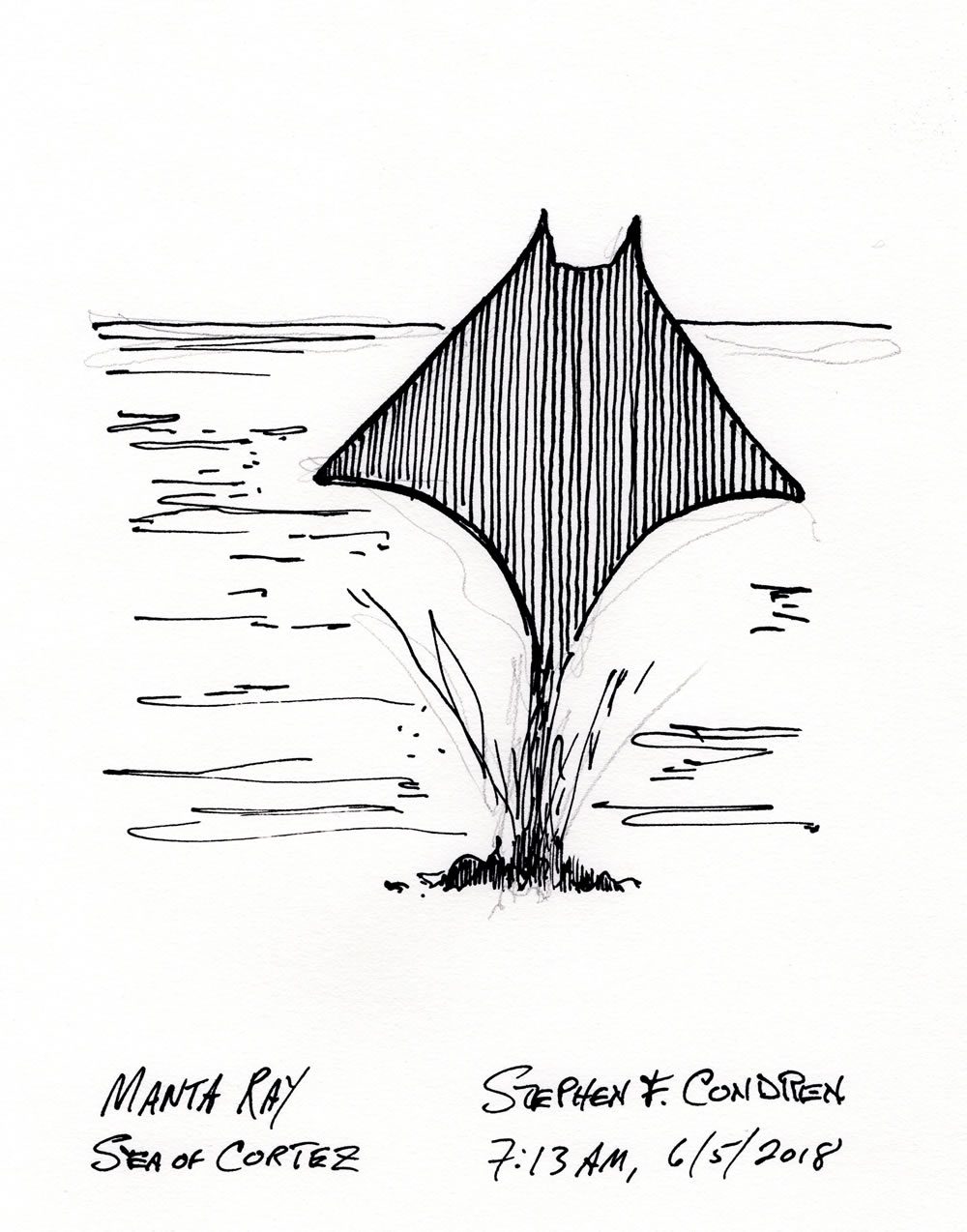
This article is about Manta ray pen & ink drawing, which is for sale at discount with prints by artist Stephen F. Condren, BFA-SAIC, of Condren Galleries, a Fine Arts Gallery, offering JPEG & PDF scans. This is a drawing of one of many manta rays that cluster together and dance, in the Sea of Cortez. This dance or streams of jumping is a ritual mating act by the rays during mating season.
Delineation
The line work for this drawing is very light because the manta is in silhouette due to the setting sun.
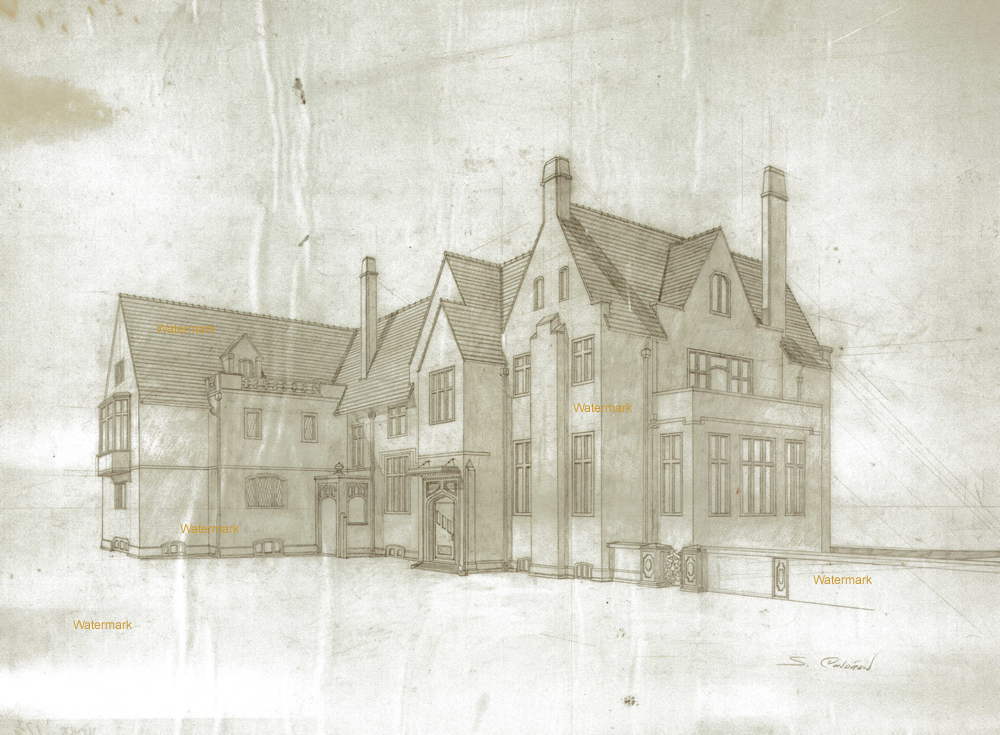
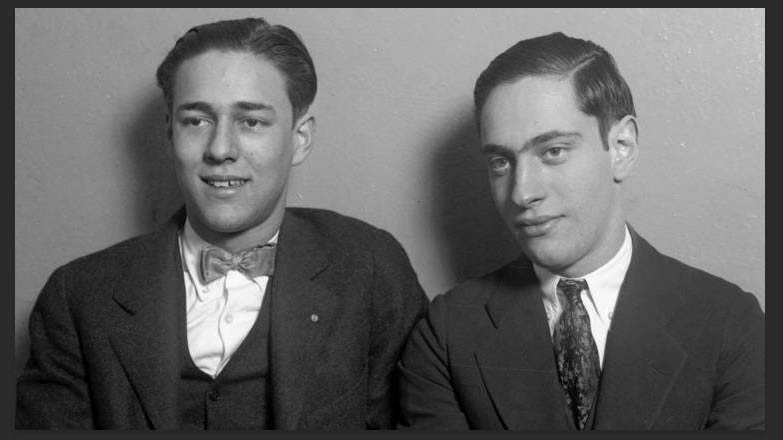
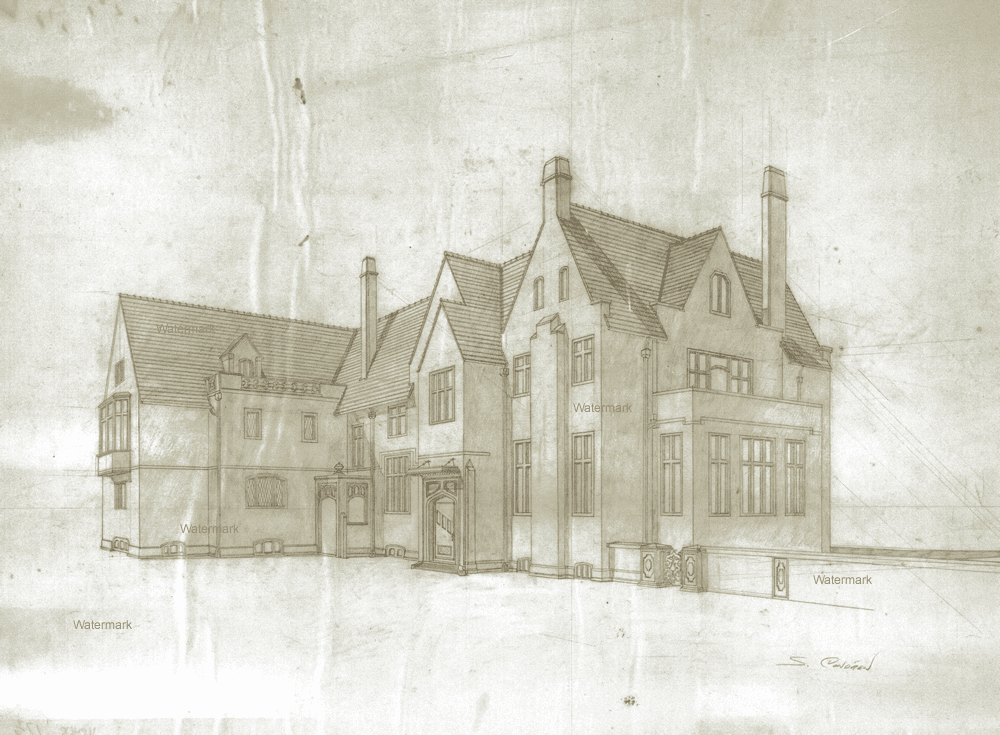
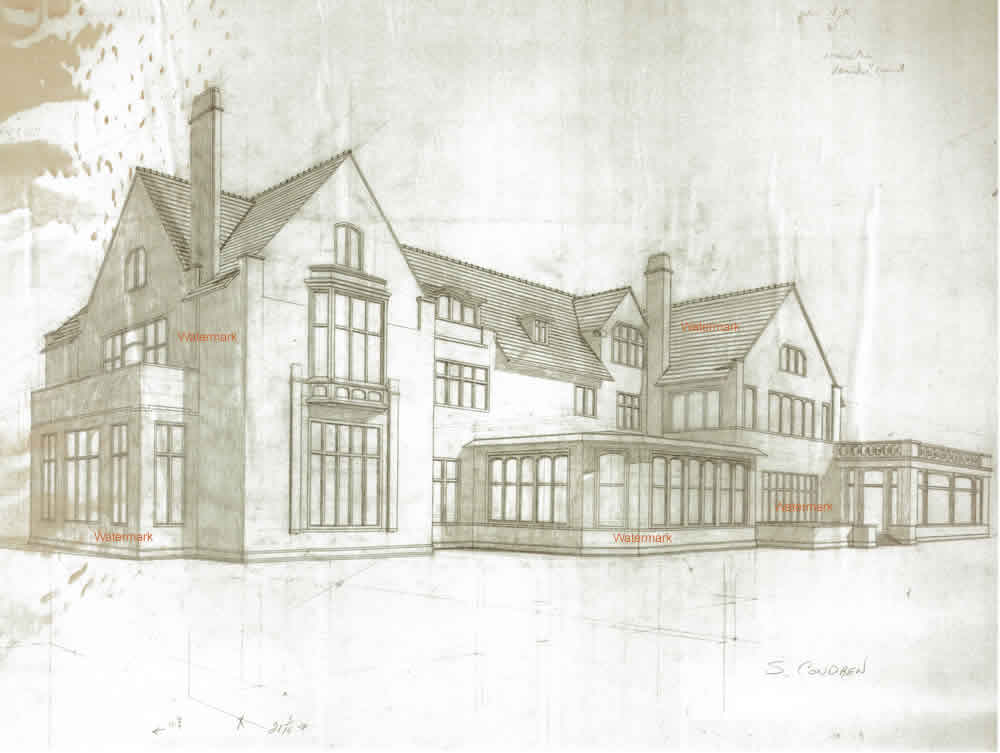
This article is about Loeb mansion blueprints #123Z, by artist Stephen F. Condren, BFA-SAIC, of Condren Galleries, a Fine Arts Gallery, offering JPEG & PDF scans. Front Façade blueprint of the Loeb Mansion in Kenwood, Chicago. In 1924 the Crime of the Century was committed by two brilliant students of the University of Chicago, Richard Loeb and Nathan Leopold. Not only were they brilliant, they were from amongst the wealthiest families in the Chicago. They lived in the ultra exclusive neighborhood over Kenwood, just north of Hyde Park in Chicago. This was and still is the mansion district of Hyde Park Township. Prints & Scans Of This Drawing #123Z ~ Order Here.
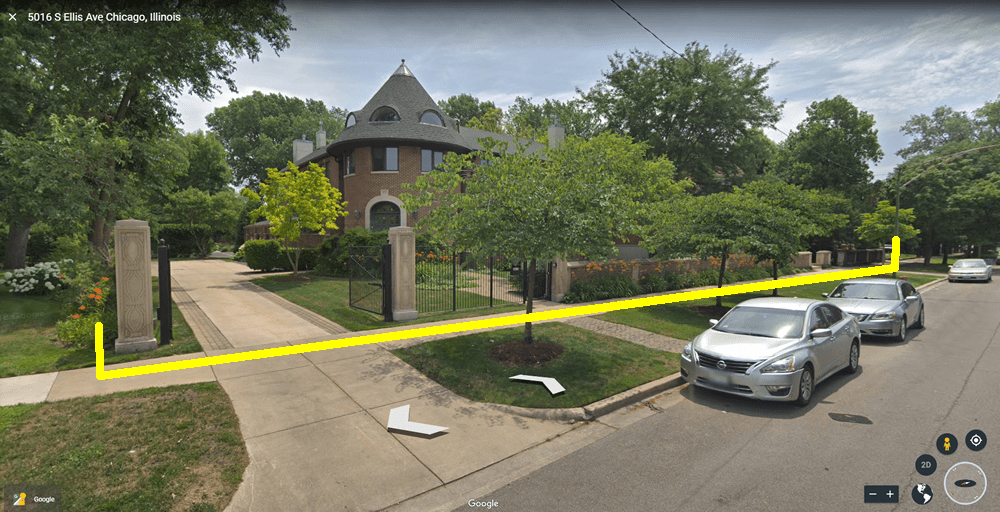
The mansion located at 5017 S. Ellis Avenue, Kenwood, Chicago, was commissioned by Albert and Anna Loeb in 1910. Though the mansion was raised in the summer of 1972, the brick wall and gate posts still remain. Note, the pedestrian post, which was to the left of the remaining post on the right side is missing. What you see in the photo below are the two posts on the left for the car, and the right post of the two pedestrian posts on the right.
The original Loeb Mansion fence and posts at 5017 S, Ellis Avenue, Kenwood, Chicago.
Photo of the mansion in 1924
Photograph of the Albert Loeb mansion at 5017 S. Ellis Avenue, Kenwood, Chicago.
Image
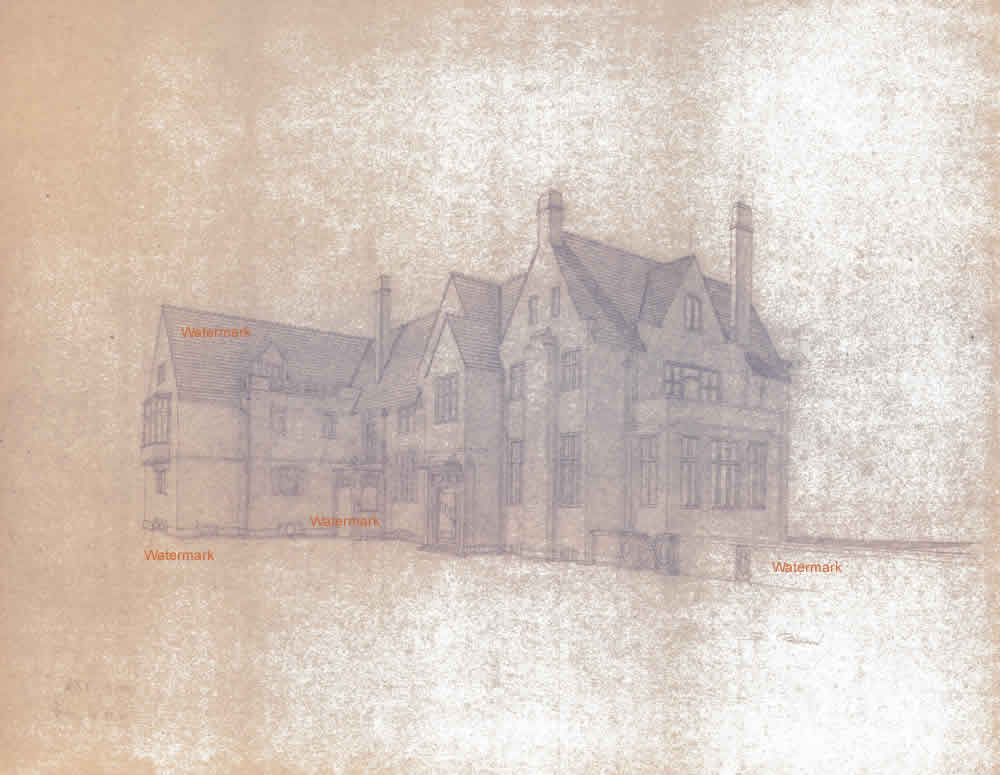
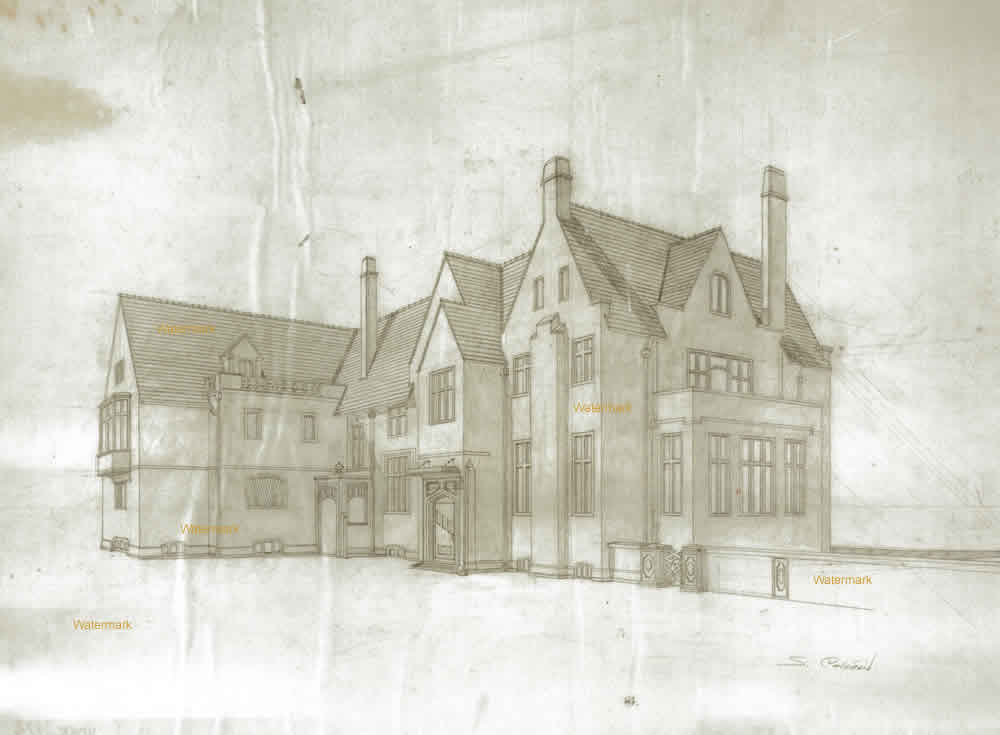
I drew there two architectural renderings when I was 20 years old and an Architecture Student in Mr. Jorgenson’s Perspective Drawing Class. The text book was “Geometry for Architects”. For the final project the class had two choices that they could. 1, A single watercolor rendering in the size of 18″ x 24″. 2, two black & white perspective renderings in the same size. I chose the later. As you can see from the image the rendering is done on vellum thus there is no “give” to the paper and therefore “What you see is what you get.”
Architecture
The address of the home was 5017 S. Ellis Avenue, Chicago, Illinois, 60615. The style of architecture of the home is Tudor. The mansion sits on at least 6 city blocks, but I am not sure of this. The property size is similar to that of the Julius Rosenwald mansion just one block to the north on the same side of the street but at the corner of Ellis and 48th streets. The house was designed so that the front faced north and the vast garden side faced the south.
Interior
The entire eastern wing was the Living Room and right above was the Master Suite that took up the same enormous area. As you entered the front door you came into a long narrow marble hall and at the end of the hall there were a few steps up that had a door that open into the entry. The entry was adequate in size but lot large by any means and just to the left was the staircase the had a landing leading up to the second floor. There was an organ built into the base of the staircase. As you turned to your left you entered a vast space which was the Solarium that looked out onto the gardens to the south.
Today these two famous renderings hang in the collection of the Chicago History Museum. Collection ID: 2005.0118.1-.3.
Delineation
The line work for this drawing is very light because of the use of fine line mechanical pencils. At this time lead holders or mechanical pencils were the work horse of the drafting industry. There was no AutoCAD or printers.
Front View ~ Architectural rendering of the Loeb Mansion from the murder trial of Leopold and Loeb of 1924 in Chicago by artist Stephen F. Condren.
Garden View ~ Architectural rendering in pencil of the Loeb mansion in Chicago from the murder trial by artist Stephen F. Condren.
Points of the skyline drawing are as follows:
Tudor Architecture
Delineation
Tudor Architecture: The style of architecture for the mansion was Tudor. The façade of the home faced north and had a spacious circle drive around the front entry with a large elm tree planted in the center of the circle. The entry had a detailed canopy and lead into a long narrow marble hall which opened to a modest sized entry at the end. Once inside the entry you would turn right to the living room or turn left to the hall with lead to a closet to the immediate left and staircase with landing just past it. The banisters were of wood and a small organ built into the wall at the base of the stairs. When you walked past the staircase you came into a vast space which lead into the solarium which opened up to the gardens and south lawns. There was a tennis court and adjacent the garage on the east side of the property. There was a ballroom on the third floor.
Delineation: The rending was down in two parts. The first parting showing the north façade and entry. The second part was of the garden façade and solarium on the south side of the property.
Discount Prices
Free shipping within 48 hours and always on sale at low discount prices ever so cheap by artist Stephen F. Condren.
This article is about Trimbakeshwar Shiva Temple #047Z Watercolor Painting #938, which is for sale at discount with prints by artist Stephen F. Condren, BFA-SAIC, of Condren Galleries, a Fine Arts Gallery, offering JPEG & PDF scans. This is my watercolor painting of Trimbakeshwar Shiva Temple in Trimbak, India.
Trimbakeshwar Shiva Temple Watercolor Painting #938. Key points to this work are as follows:
Composition.
Shade and shadowing.
Composition: This is a complex composition because of the location of the temple in the village of Trimbak, and is juxtaposition with the mountains behind. The temple lies at the edge of town near the market of Trimbak and so it is always full of visitors and worshipers.
Shade and shadowing: I have made extensive use of hatching and cross hatching in this work of art. The nature of the design of the temple immediately lends itself to intricate linear detailing. This kind of structure certainly does not fall into Mies Van Der Rohe dictum of “less is more”. Nonetheless, this wonderful temple offers plenty of “more” and my watercolor is here to display this. I have played down the greenery in the landscape behind the temple so that it does not force its way between the mountains that form an amazing backdrop to the inspiring scene. The richness and beauty of India stands before us.
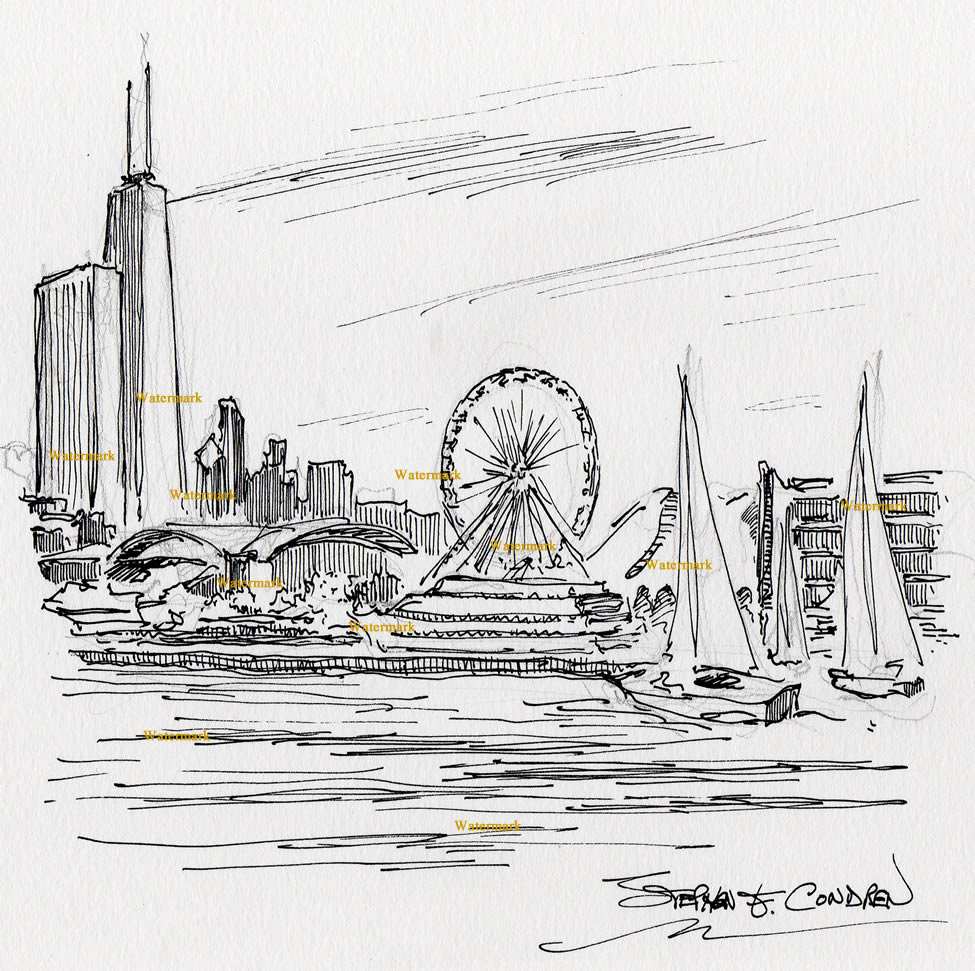
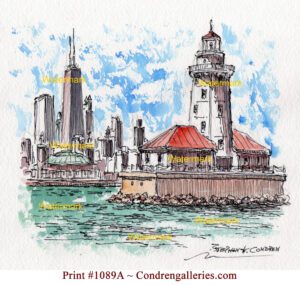
This article is about Chicago Navy Pier #046Z Pen & Ink Drawing and John Hancock Center, which is for sale at discount with prints by artist Stephen F. Condren, BFA-SAIC, of Condren Galleries, a Fine Arts Gallery, offering JPEG & PDF scans. This is my pen & ink drawing of Chicago Navy Pier in Chicago, Illinois.
Chicago Navy Pier Pen & Ink Drawing #941. Key elements to this drawing are as follows:
Chicago skyline.
Pen & Ink.
Horizon.
Chicago skyline: The backdrop of this scene is the cluster of skyscrapers that are at the core of Streeterville, on Chicago’s near north side. At the center of the cluster is none other than the famous John Hancock Center. The skyline makes for a wonderful support to the balance of the Drawing which centers on the Centennial Wheel and then move to the right and stops on the sail boats that are casually sailing on Lake Michigan.
Pen & Ink: I have chosen to draw this scene in pen & ink. Pen & ink work very well with this kind of scene. The sail boats on the right balance out the composition and all the images are gently resting in the hands of the John Hancock Center. The line strokes are ever to carefully places so as not to give that “hatching” effect, but rather I wanted all of the line work in the drawing to be structural. Note the delineation on the John Hancock Center and it’s neighbor, Water Tower Place. All of the ink lines in these buildings have nothing to do with shade or shadow but rather with contour and structure. Because of this, the lines that form the other elements of the drawing all fall into place.
Horizon: The vantage point for this drawing is square on the horizon line. It looks as though we are a bit below the horizon line but we are not. We are close to the water’s edge and above the decks of the sail boats. The horizon line has to be low for this kind of drawing to fit in all of the tall elements, even the tips of the boat sails go up beyond the half way point!
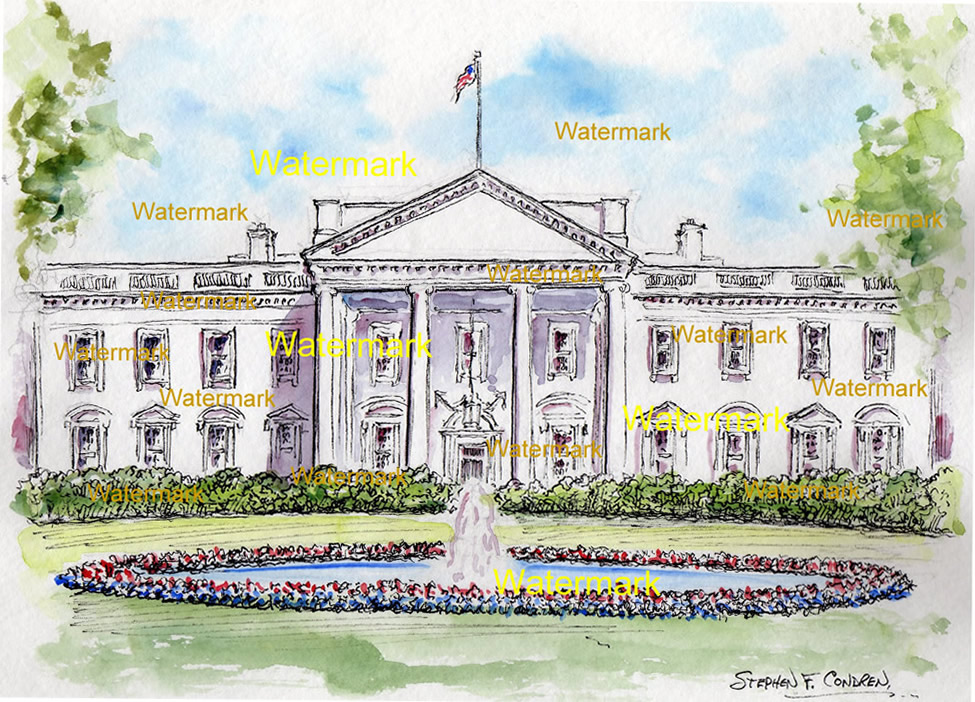
White House #010Z, pen & ink drawing, also in pencil and watercolor, is a critical treatise because this is a work of Fine Art.
The “White House #010Z” is a refined work of art because it shows high contrasting tones. This “White House #010Z” is a strong work of art because the contour lines show the outline while the hatched lines show the shading. The post to this rendering is “SKU #673A.”
Choose from scans, framed prints, large prints, and the original work of art because they vary in size.Better Business Bureau Complaint Free Award is given to me every year because I provided my clients with outstanding service and professional handling. Always feel free to contact me if you have any questions because I am the artist.Certificate of Authenticity is included with every print or original work of art because I am the artist. I personally sign and date each certificate proving the authenticity of the work of art, or signed print, because I am the artist.Free shipping for Condren Galleries because it is included in the cost of the artwork.
The White House in Watercolor #673. To do a good watercolor of any structure it is recommended to do the following:
Either get a good photograph of the structure, or if on site, position yourself so that you have a full view of the subject.
Determine the perspective vanishing points.
Have all of your artist materials close at hand so as to avoid interruption on the work do to breaks.
The White House, located at 1600 Pennsylvania Avenue is without doubt the most famous house in the world. This Georgian style house is the focal point of many political issues, however, my interest in the house is from the standpoint of Art. I will address only the central block of the house in this article.
The two-story mansion is the residence of the President of the United States and his or her family. This splendid home is difficult to address because it is so famous and is the focus of so many images. So please try to think of the house as a work of art because of its beauty. Rather than the center of political attention because it is a work of art. Looking at the White House immediately we see that it is simple in design and not at all as lavish as many other mansions in the country are, e.g. The Breakers in New Port, Biltmore House in Asheville, and Hearst Castle in San Simeon.
Architecture of the White House
The central block of the building is rectangular in shape and is wider than it is long, the main entry faces north with a grand portico supported by two-story tall white Grecian pillars. The driveway is ample in servicing residential traffic needs. The back side of the house faces the south and is the garden entrance. The difference of the facade is that the center of the house is curved with a balcony around the curve. Many people wrongly think that the Oval Office is located here on the second floor when in fact it is located on the ground floor in the corner of the west wing a good distance from the central block of the house (though connected by internal corridors).
Both sides of the home have extensive gardens, and each has a large fountain with sprays at the center. The fountain on the front lawn is usually decorated with ornamental flowers in the patriotic colors of red, white, and blue. When looking at the windows of the house you will note that there is a staggered pattern of a curves that angel above each window. There are four windows across on each side and the second-floor windows are aligned with those directly below. The upper floor windows are smaller and are not as embellished with as much details as their counter parts below.
With regard to proportion the garden face is far superior to the main entry. The portico proportions do not match the scale of the house, and it is too tall, whereas the proportions on the garden face are splendid needing no adjustments.